
23rd March - A Place to Pause: London, Uncertainty, and the Adaptable Home
I've been wondering how global uncertainty is starting to shape where — and how — people choose to live.
With ongoing instability in the Middle East, and the situation involving Iran in particular, could we begin to see a subtle shift in behaviour? Not necessarily a dramatic movement, but a growing preference for stability and flexibility. The clients I'm speaking to aren't panicked — they're recalibrating. Decisions that might once have been made on a five- or ten-year horizon are now being made on a one- or two-year one. Plans that once involved buying a long-term family home are quietly being rethought as extended rentals. The thinking isn't "we need to leave" — it's "we want to keep our options open."
In London, the prime rental market already feels active — driven in part by globally mobile clients who are choosing to rent rather than buy while the wider picture remains uncertain. There is certainly no sign of a "war-driven" boom; it's far too early to tell, and I'd be wary of anyone making that claim. But there is a noticeable shift in tone among the people coming through our door. Renting at the top of the market used to feel like a stopgap. Increasingly, it's a deliberate choice.
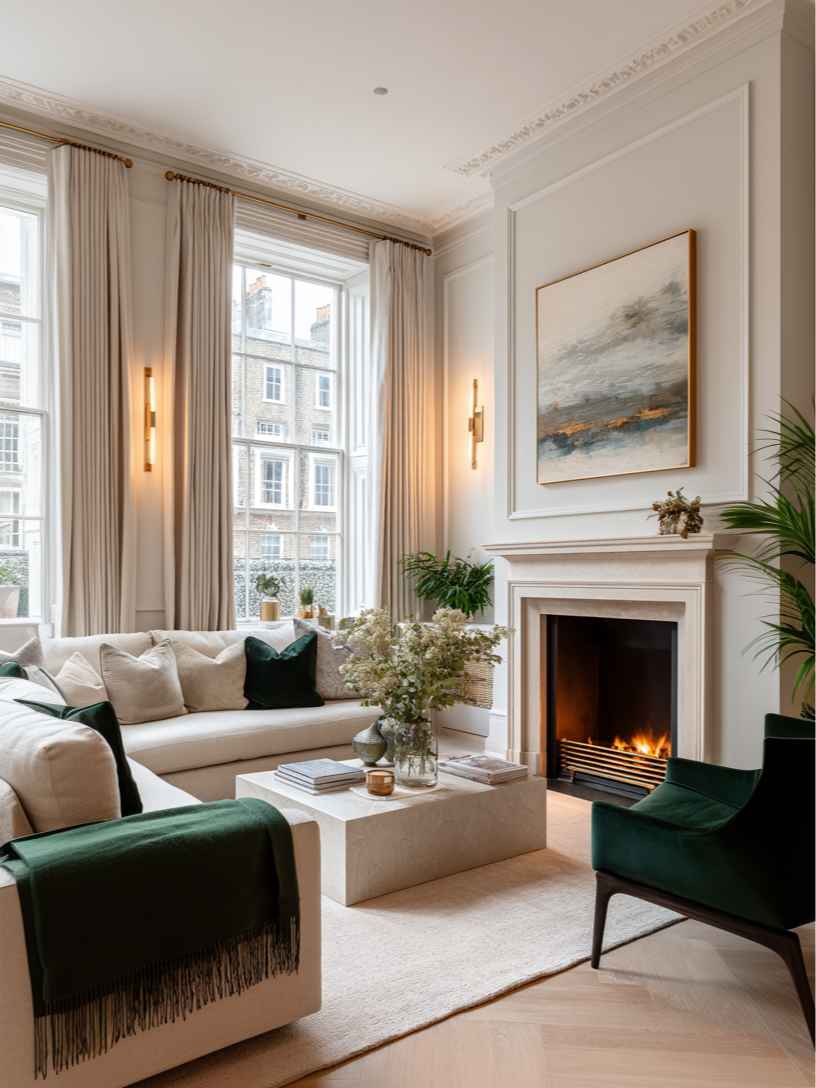
Central London Apartment for International Clients
It raises an interesting question: are more people starting to view the UK, and London in particular, as a place to pause — somewhere stable, familiar, and adaptable in the short to medium term? Historically, London has tended to attract capital during periods of instability, as people seek certainty. Education, the legal system, language, time zone, and the simple fact that the city remains genuinely liveable — these things matter more, not less, when the wider world feels harder to predict.
At Matthews Rea Interiors, this is shaping the conversations we're having. There has been a noticeable emphasis on creating spaces that feel calm, considered, and ready for real life — not designed for a single moment, but for whatever comes next. Clients are asking for homes that flex: rooms that can change use as life does, joinery that can be reconfigured rather than ripped out, schemes built around materials that age beautifully rather than date quickly. The brief, more often than not, is "make it feel like ours — even if 'ours' is only for the next two or three years."
I can see this becoming more important, not less, in the months ahead. A home that is genuinely adaptable — that holds its character through whatever the world throws at it — is no longer a nice-to-have. For globally mobile clients in particular, it's becoming the brief itself.